
Brent crude briefly spiked to $119.50 a barrel on Monday before settling around $107.80, as Trump’s war in Iran continues to choke off roughly 20% of the world’s oil supply that normally flows through the Strait of Hormuz.
The international benchmark hasn’t traded this high since 2022, when Russia invaded Ukraine. West Texas Intermediate, the U.S. crude standard, hit $119.48 before falling back to $103.
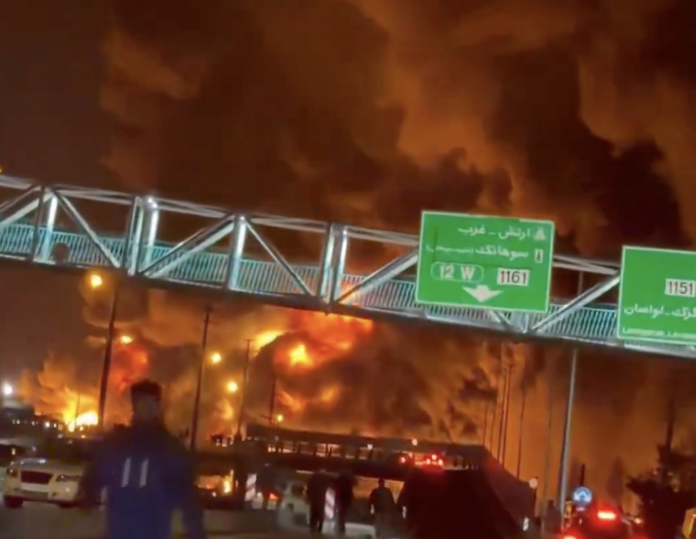
The price surge came as the war’s civilian toll mounted. Bahrain accused Iran of striking a desalination plant critical to drinking water, while oil depots in Tehran continued to burn following overnight Israeli strikes.
🚨 THE US AND ISRAEL JUST BOMBED A MAJOR OIL DEPOT IN IRAN.
— Bull Theory (@BullTheoryio) March 8, 2026
After the airstrike, oil spilled from the depot into the streets, entered the sewers and drainage systems, then caught fire, creating walls of flame on the highway of Tehran.
This was the first major hit on Iran's oil… pic.twitter.com/M2Mhs1EVtG
Iranian tanker traffic through the Strait of Hormuz—bordered by Iran and carrying crude from Saudi Arabia, Kuwait, Iraq, Qatar, Bahrain, and the UAE—has effectively stopped due to missile and drone threats. Iraq, Kuwait, and the UAE have already cut production as storage tanks fill up with nowhere to go.
Prices moderated slightly after the Financial Times reported that some G7 nations were considering releasing strategic oil reserves. Trump, naturally, dismissed the idea on Saturday, insisting American supplies were “ample” and prices would fall soon.
Energy Secretary Chris Wright went on CNN’s “State of the Union” to reassure Americans that gas would be back under $3 a gallon “before too long.” He added, “in the worst case, this is a weeks, this is not a months thing.”
Americans aren’t feeling that optimism at the pump. A gallon of regular gas hit $3.45 on Sunday—up 47 cents from a week ago. Diesel jumped 83 cents to about $4.60 a gallon.
The ripple effects are global. Tokyo’s Nikkei 225 dropped 5.2% on Monday. U.S. futures fell more than 1.5%. The S&P 500 had already shed 1.3% on Friday, with the Dow plunging as many as 945 points before recovering slightly.
Iran’s parliament speaker, Mohammad Bagher Qalibaf, warned that the war’s impact on oil would only spiral. Iran currently exports about 1.6 million barrels daily, mostly to China—which may need to find new suppliers, pushing prices even higher.
Some analysts say oil above $100 a barrel could be more than the global economy can handle.