
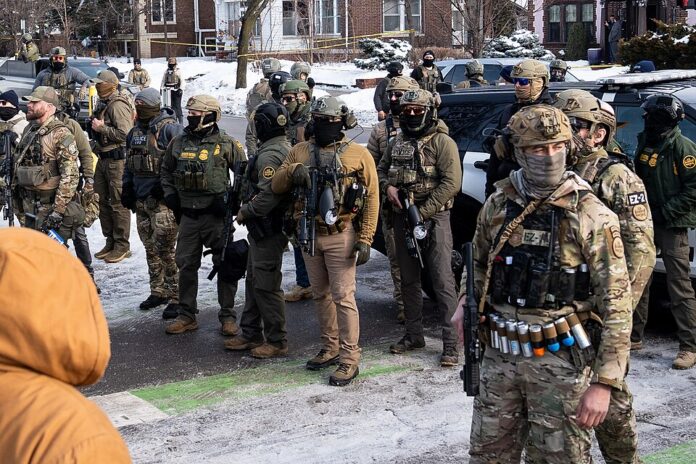
The Trump administration is deploying Immigration and Customs Enforcement agents to airports starting today — not to screen bags, not to check boarding passes, but to stand near exit doors so actual TSA agents can go do the jobs they’re not being paid to do.
There’s just one problem beyond the obvious ones: ICE itself had no idea this was happening.
“I have no idea what we’re doing,” one DHS official told CBS News when asked about the president’s decision. Multiple DHS sources told the outlet that ICE officials were caught flat-footed and are scrambling to figure out how to enforce Trump’s last-minute proclamation.
So the agency that killed two American citizens in Minneapolis in January is now being rushed into airports with no plan, no training, and apparently no advance warning from its own boss.
More than 400 TSA agents have quit since the partial government shutdown began on February 14. Others are calling out sick. Lines at security checkpoints have stretched for hours. At New Orleans’ airport on Sunday, the line snaked out to the parking lot. LaGuardia looked the same.
Rather than pay the people who actually know how to keep airports safe, Trump posted on Truth Social that ICE would “do Security like no one has ever seen before.” Which is one way to describe armed immigration agents with zero aviation security training standing around an airport they weren’t told they’d be at until the day before.
Border czar Tom Homan went on CNN’s State of the Union on Sunday and laid out the grand plan: ICE agents will guard exits. That’s it. “How much of a plan does it mean to guard an exit to make sure no one comes through an exit?” he said, apparently thinking this was a compelling argument.
A former senior ICE official told CBS News that federal immigration agents were likely not trained to perform the technical tasks involved in airport security, such as operating screening machines. The former official added that using Customs and Border Patrol agents — who already work at international airports conducting immigration checks — would have been the more logical choice.
But logic isn’t the point here.
Here’s the part the administration would really prefer you not focus on: this entire crisis is manufactured. Senate Democrats blocked funding for the Department of Homeland Security — which oversees TSA — because they’re demanding reforms after ICE agents killed Renee Good and Alex Pretti, both U.S. citizens, in separate incidents in January. Trump is holding 50,000 TSA workers’ paychecks hostage to protect the agency that did the killing.
And now he’s sending that same agency into airports — surprised and unprepared.
“The last thing that the American people need are for untrained ICE agents to be deployed at airports all across the country, potentially to brutalize or in some instances kill them,” said House Democratic leader Hakeem Jeffries on CNN. “We have already seen how ICE conducts itself.”
Everett Kelley, president of the American Federation of Government Employees, which represents more than 50,000 TSA workers, said: “Our members at TSA have been showing up every day, without a paycheck, because they believe in the mission of keeping the flying public safe. They deserve to be paid, not replaced by untrained, armed agents who have shown how dangerous they can be.”
A joint statement from U.S. flight attendant unions called the deployment “another distraction from solutions that protect Americans” and labeled it an “ICE invasion at the airports.”
Even Republican Senator Lisa Murkowski called it a “bad idea.”
Many online thought this was the plan all along: defund TSA, overfund ICE, and then replace TSA agents with masked, armed, untrained agents at ports of entry.
So to recap: Trump refuses to end the shutdown. TSA agents work without pay. Hundreds quit. Airport lines become unbearable. Trump blames Democrats. Then he sends in ICE — the agency at the center of the entire standoff — as the solution. And ICE found out about it roughly the same time the rest of us did.
Homan pledged to have a plan finalized by end of day Sunday — for a deployment starting Monday morning.