
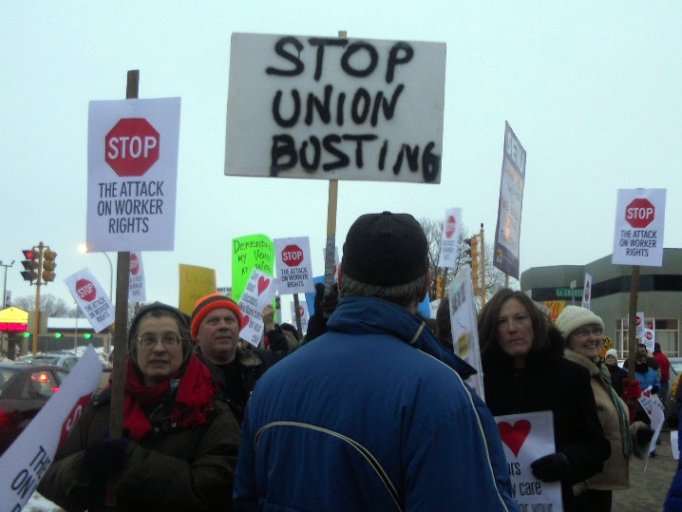
Nearly half a million American workers joined unions in 2025, pushing total union membership to its highest level in 16 years—a direct rebuke to the Trump administration’s relentless assault on organized labor.
The AFL-CIO announced Wednesday that 499,000 workers organized last year, bringing total union membership to 14.9 million, the most since 2009.
The surge comes despite—or perhaps because of—a federal government openly hostile to workers’ rights. Trump’s second term has featured gutted labor protections, stacked anti-union appointments to the National Labor Relations Board, and executive orders designed to make organizing harder.
Workers responded by organizing anyway.
The numbers represent a continuation of the labor revival that’s been building since the pandemic, when workers at Starbucks, Amazon, and other major corporations started winning elections at a pace not seen in decades. That momentum hasn’t slowed, even as the legal and political terrain has shifted dramatically against unions.
The AFL-CIO, which represents 56 national and international labor unions and 12.5 million workers, framed the numbers as proof that working people won’t be intimidated.
Union density—the percentage of workers who belong to unions—remains historically low compared to the mid-20th century peak, when roughly a third of American workers were organized. But the raw membership numbers tell a story of resilience.
For context: when unions are strong, wages rise, benefits improve, and workplaces get safer. When they’re weak, the gains go to shareholders and executives. The past four decades of declining union power track almost perfectly with the explosion of income inequality.
The workers who organized in 2025 apparently understood that math.