
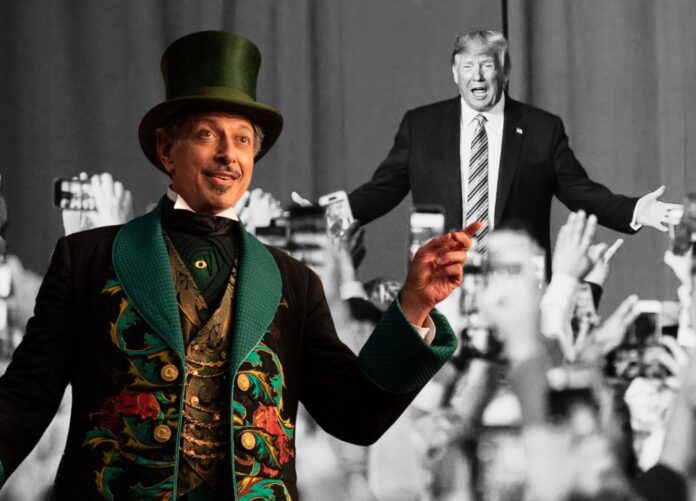
I fell in love with the musical Wicked when it came out twenty years ago and I was a college freshman. But two decades later, watching the new movie, I finally understand why it hit so hard then—and why it matters even more today.
It’s because the show isn’t really about witches. It’s about branding.
The “Wicked Witch of the West,” whose real name is Elphaba, isn’t wicked at all. She’s enraged by the treatment of talking animals—who are being stripped of their rights by an authoritarian ruler who’s a master at propaganda.
When she dares challenge the Wizard of Oz and his press secretary, they brand her “wicked” and launch a massive (and magic-infused) campaign to make everyone believe it.
In the second act—now the second movie—there’s a scene where the Wizard drops his mask. He knows exactly what he’s doing. This isn’t incompetence. It’s strategy. He’s a P.T. Barnum figure who understands something Elphaba doesn’t: the truth doesn’t set people free.
Elphaba’s whole approach is built on a faith I recognize: if people know the truth, they’ll reject the lies.
The Wizard knows better than this. And in newly added lyrics for the movie, he explains why:
Take it from a wise old carny
Once folks buy into your blarney
It becomes the thing they’ll most hold onto
Once they’ve swallowed sham and hokum
Facts and logic won’t unchoke ‘em
They’ll go on believing what they want to
Show them exactly what’s the score
They’ll just believe it even more.
The Trump allusion isn’t subtle. But it’s true.
As a journalist and a liberal, I grew up with Elphaba’s faith. I thought: If people know the truth, they’ll change.
I spent years believing that exposing Trump’s lies, his corruption, his cruelty would eventually break through. That the facts would matter.
They didn’t. The more he was revealed as a fraud, a cheat, a predator, the more his base loved him. Because once people buy into the mythology—once they’ve invested their identity in it—facts become the enemy. They don’t undo belief. They strengthen it.
This is how cults work. And for his most die-hard followers, Trump is exactly that—a cult-like figure whose lies become sacred truths.
What Elphaba realizes by the end of the movie is that if you want real change, you can’t just tell the truth and hope it wins. You have to understand the game being played—and play it better.
Liberals and progressives need to learn the same lesson. Not just about Trump, but the system that got us here in the first place.
Standing up to the grotesque inequality that laid the groundwork for Trump’s fascism—fighting the system that keeps people desperate, afraid, and angry—requires more than facts. It requires a counter-narrative as powerful as the one we’re up against.
For decades, capitalists ran exactly this kind of campaign against socialism. They didn’t win with facts. They won by linking anything remotely fair or democratic to Chinese famines and Soviet gulags. They made “socialism” a synonym for horror.
It worked so well that entire generations recoiled from workplace democracy, from economic security, from the very idea of a society built on something other than extraction and exploitation. They internalized their own oppression and believed it was human nature.
If we want to actually change this—we must do the same thing, only in reverse.
Call it raising class consciousness. Call it a propaganda campaign. Call it whatever you want. But we need a massive, relentless effort to paint the real villain: exploitative capitalism.
Not capitalism as an abstract concept, but the actual system—the one that leaves people bankrupt from medical bills, that lets landlords price families into homelessness, that lets billionaires buy elections while workers can’t afford groceries. The system that makes people so desperate and afraid that they’ll follow a con man who promises to burn it all down.
The Wizard wins because he understands that people don’t follow logic. They follow stories. They follow villains and heroes. They follow whoever makes them feel like their anger has a target and their fear has a solution.
If we want to build a moral economy—one where everyone has the basic necessities of life without fear, and a democratic say in the decisions that affect them—we can’t just explain it.
We have to make people feel the injustice of the system we have now. We have to name the villain. We have to make the case so viscerally that people can’t ignore it.
Elphaba spent most of the story believing the truth would win. It didn’t. What won was the better story, the more powerful brand, the sharper mythology.
It’s time liberals stop playing Elphaba and start understanding the game the Wizard already knows he’s playing.