
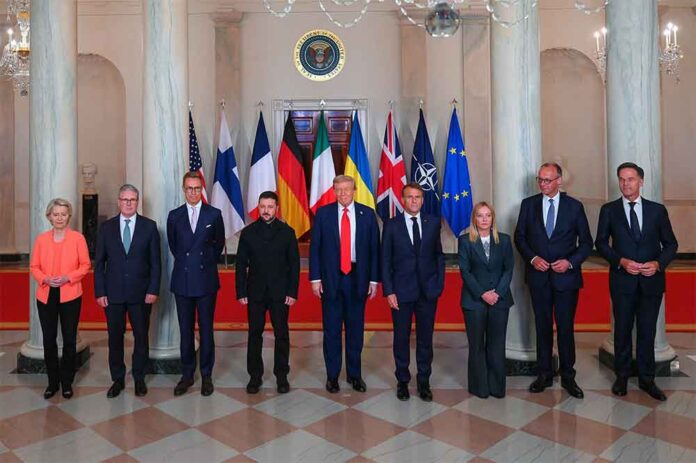
European leaders have finally figured out how to do something they’ve struggled with for over a year: say “no” to Donald Trump. And they’re doing it together, loudly, and in public.
WHAT’S GOING ON: After months of flattering Trump with royal treatment and fawning praise—NATO’s secretary general literally called him “daddy” last year—Europe’s leaders have had enough.
The breaking point? Trump’s renewed demand that the U.S. “absolutely” must take over Greenland, the semiautonomous region belonging to NATO ally Denmark, complete with threats to punish any country that resists.
“Britain will not yield,” declared British Prime Minister Keir Starmer. “Europe will not be blackmailed,” echoed multiple continent leaders. Norwegian Prime Minister Jonas Gahr Støre put it plainly: “Threats have no place among allies.”
Trump, characteristically, didn’t take it well. “We want a piece of ice for world protection, and they won’t give it,” he told his audience at the World Economic Forum in Davos. “You can say yes, and we will be very appreciative. Or you can say no, and we will remember.”
THE DETAILS: The dramatic shift from appeasement to defiance offers a playbook for standing up to Trump, according to AP News.
First: speak as one. When Europe united in rejecting Trump’s demands, results followed. “When Europe is not divided, when we stand together…then the results will show,” Danish Prime Minister Mette Frederiksen said. “I think we have learned something.”
Second: actually say no. Greenland’s prime minister Jens-Frederik Nielsen did just that: “Enough. No more pressure. No more hints. No more fantasies about annexation.”
Third: reject Trump’s framing entirely. Canada’s Mark Carney urged Europe to stop accepting the “fiction” that the alliance exists for any country’s benefit more than America’s, and called Trump’s approach what it is: “coercion” and “exploitation” from a “bully.”
BUT BUT BUT: Trump isn’t backing down just because of European unity. He’s facing sinking poll numbers, a wobbly stock market, midterm elections in November, and domestic backlash to immigration raids in Minnesota.
Before he even left the Davos podium, he’d begun walking back his threats—canceling talk of using “force” to take Greenland and suddenly announcing “the framework” for a deal.
WHY IT MATTERS: For a year, European leaders tried the “old rules of diplomacy” with Trump, expecting measured conversations would eventually bring him around. It didn’t work.
As Mark Shanahan, associate professor at the University of Surrey, put it: “It’s very hard for other leaders who deal with each other through the niceties of a rules-based system and diplomatic conversation. It is hard for them to change.”
They’ve changed now. Denmark’s leader warned that any invasion of Greenland would mark “the end of NATO.” And when Trump claimed victory with his mysterious “framework,” Frederiksen hit back immediately: “We cannot negotiate on our sovereignty.”
In other words: No.