
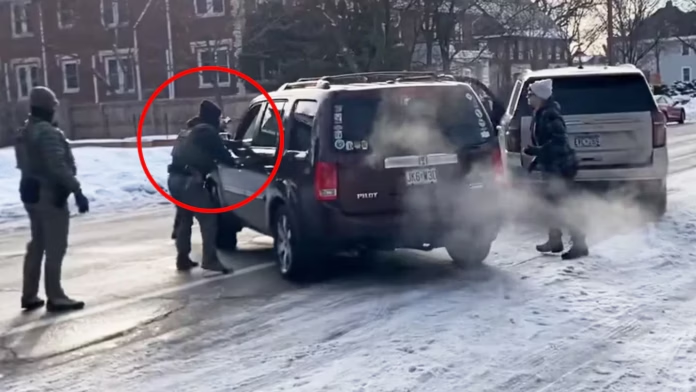
The ICE agent who killed Renee Nicole Good in Minneapolis used a tactic that nearly three-quarters of major police departments have specifically banned because it’s dangerous and unnecessary: shooting at a moving vehicle.
WHAT’S GOING ON: Good, a 37-year-old mother of three and poet, was shot and killed by an ICE officer while sitting in her car. Videos show one officer trying to open her car door while another positioned himself in front of the vehicle as she tried to pull away. The officer fired, killing her.
Here’s the thing: ICE’s own policy prohibits officers from “discharging firearms at the operator of a moving vehicle” unless necessary to stop a grave threat, and explicitly states deadly force should not be used “solely to prevent the escape of a fleeing suspect.”
But unlike most police departments and even the Department of Justice, ICE’s policy lacks a critical instruction: telling officers to simply get out of the way of moving vehicles where feasible.
THE DETAILS: The omission isn’t just bureaucratic sloppiness—it’s a known gap. In 2022, President Biden issued an executive order requiring federal law enforcement agencies like ICE to adopt use-of-force policies that match or exceed DOJ standards. The DOJ explicitly tells officers not to shoot at vehicles if they can protect themselves by “moving out of the path.” That provision never made it into ICE’s policy.
According to Ben Jones, an assistant professor of public policy at Penn State who researches police ethics, the physics here are simple: shooting a driver rarely stops a moving car. The vehicle keeps going.
So, positioning yourself in front of a car and then claiming you “feared for your life” creates the very danger you’re citing to justify deadly force. Law enforcement experts call this the “death box”—a situation officers create that leaves them with no option but to shoot.
View on Threads
WHY IT MATTERS: This isn’t theoretical. When the NYPD prohibited shooting at moving vehicles decades ago, police killings dropped without putting officers in greater danger. A recent analysis found that close to 75% of police departments in the 100 largest U.S. cities now prohibit the tactic.
Of course, Homeland Security Secretary Kristi Noem defended the shooting, claiming the ICE officer “feared for his life”—despite video and witness accounts that don’t support the administration’s narrative that agents were “surrounded and assaulted.”
BOTTOM LINE: ICE operates under weaker rules than most local cops, even after being ordered to match DOJ standards. When agencies close the gap between policy and best practices, lives get saved.
When they don’t, people like Renee Nicole Good end up dead.