
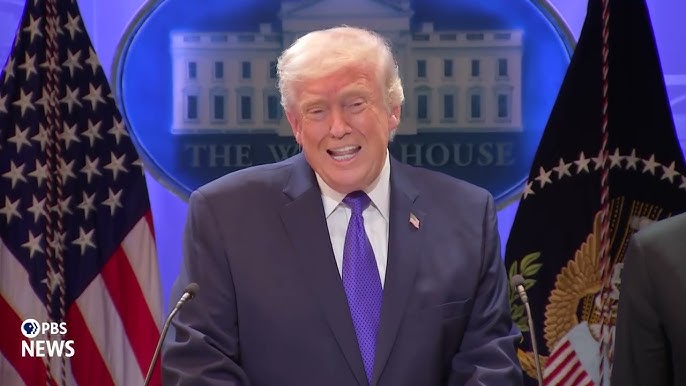
Hours after the Supreme Court struck down his illegal tariffs, Donald Trump stood at a lectern and rambled about his supposed power to “destroy” countries—insisting the ruling was somehow proof of his strength.
“The court has given me the unquestioned right to ban all sorts of things from coming into our country—to destroy foreign countries,” Trump claimed to reporters. “I can destroy the trade, I can destroy the country, I’m even allowed to impose a foreign country-destroying embargo. I can do anything I want—but I can’t charge one dollar.”
This is Trump’s way of coping with a crushing legal defeat: bragging about hypothetical powers he hasn’t actually tried to use while fuming that the Supreme Court—three of whose members he appointed—had the audacity to tell him no.
The 6-3 ruling found that Trump’s use of the International Emergency Economic Powers Act to impose sweeping “reciprocal tariffs” was an unconstitutional power grab. Chief Justice John Roberts wrote that the actual language in IEEPA “cannot bear the weight” of Trump’s tariff scheme, and that Congress, not the president, holds the power to impose tariffs during peacetime.
Trump couldn’t wrap his head around it.
“I’m allowed to embargo them, I’m allowed to tell ’em you can’t do business in the United States anymore, ‘We want you out of here!'” he ranted. “But if I want to charge them $10 I can’t do that. Think of that, how ridiculous is that?”
His response to the ruling? Announce new 10 percent tariffs under Section 232, a national security provision, starting in three days. He’s essentially daring the courts to stop him again.
Trump learned of the decision while attending a White House breakfast with governors. CNN reported he became enraged, at one point ranting about “these f—king courts.” He called the justices who ruled against him—including his own appointees Neil Gorsuch and Amy Coney Barrett—”slimeballs.”
“I don’t think the court meant it, because the court doesn’t show great spirit toward our country, in my opinion,” Trump said, suggesting the justices had been compromised by foreign interests. “It’s almost like it’s written by not smart people.”
When asked whether his administration would abide by the order and issue refunds to countries affected by his tariffs, Trump barked that attempting to do so would result in the topic being relitigated for the “next five years.”
A reporter pressed: “Why didn’t you work with Congress to enact a tariff plan?”
“I didn’t have to,” Trump insisted.
He did, in fact, have to. That’s the entire point of the ruling. But Trump has never let constitutional limits stop him before, and his announcement of fresh tariffs suggests he doesn’t plan to start now.