
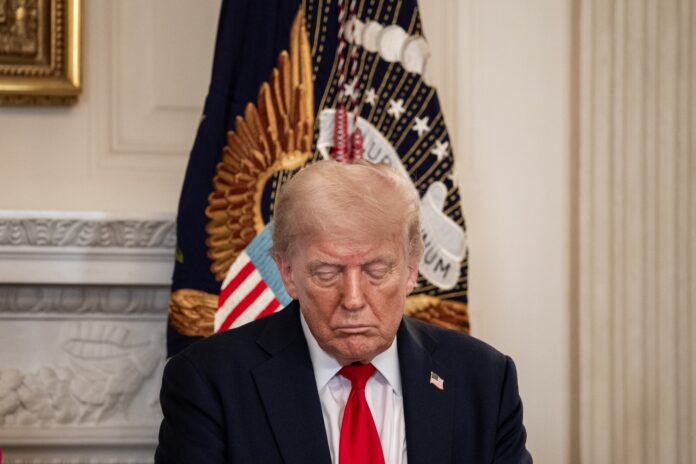
In an interview with New York magazine, 79-year-old President Donald Trump couldn’t remember the word “Alzheimer’s”—the neurological disease that killed his father—while discussing his own brain health.
“He had one problem,” Trump said of his late father Fred Trump, who died in 1999. “At a certain age, about 86, 87, he started getting, what do they call it?” The 79-year-old president pointed to his forehead and looked expectantly at White House press secretary Karoline Leavitt, who supplied the word for him.
“Alzheimer’s,” she said.
THE DETAILS: When reporter Ben Terris asked if cognitive decline was something Trump ever thinks about, the president was remarkably cavalier. “No, I don’t think about it at all. You know why? Because whatever it is, my attitude is whatever.”
Whatever it is. The leader of the free world just shrugged off the possibility of having the same degenerative brain disease that afflicted his father.
View on Threads
OF COURSE: This moment comes amid a mounting pile of concerning incidents. Trump has repeatedly claimed he’s taken multiple cognitive tests after several mysterious hospital visits for what the White House has described only as vague “exams.”
Last week at Davos, he sported a massive bruise on his hand that he attributed to taking a “big aspirin”—an explanation that left medical experts scratching their heads. Doctors have theorized the discoloration could indicate something far more serious than an oversized pill.
WHY IT MATTERS: The man with access to the nuclear codes can’t recall the name of one of the most common forms of dementia—one with personal relevance to his own family history. And his response to questions about his mental fitness? “Whatever.”
This isn’t just a senior moment. This is the president of the United States publicly demonstrating the exact kind of word-finding difficulty that characterizes early cognitive decline, while simultaneously dismissing any concern about his mental acuity.
The American public deserves transparency about whether their commander-in-chief is cognitively fit for office—not a shoulder shrug and a “whatever.”