
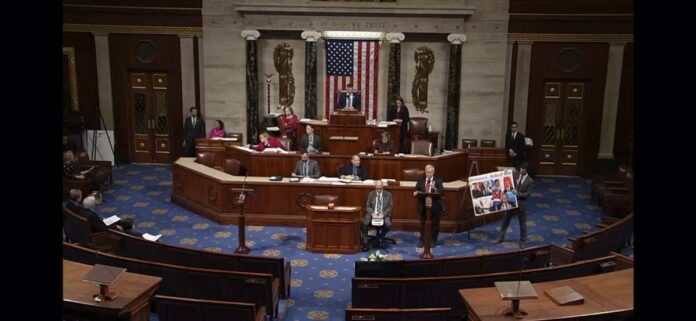
Twenty-two million Americans just got a lifeline they weren’t supposed to have—because nine House Republicans told their own leadership to pound sand.
A bipartisan coalition in the House voted 221-205 on Wednesday to advance legislation extending enhanced Affordable Care Act subsidies that expired last month. The vote came after four GOP centrists joined Democrats in a discharge petition to force the issue onto the floor, completely bypassing Speaker Mike Johnson and Republican leadership who wanted the subsidies dead.
WHAT’S GOING ON: The enhanced subsidies, originally a pandemic-era measure, had been keeping health insurance costs affordable for roughly 22 million people. When they expired in December, many Americans faced soaring premiums starting this month. Republican leadership refused to hold a vote on extending them, so Democrats used a rarely successful procedural maneuver called a discharge petition to go around them entirely.
The four Republicans who signed the petition—Mike Lawler of New York, plus Brian Fitzpatrick, Robert Bresnahan, and Ryan Mackenzie from Pennsylvania—all represent competitive swing districts. In the final vote, nine Republicans total crossed party lines.
THE DETAILS: The bill proposes a three-year extension of tax credits for people who buy insurance through the ACA. Final passage is expected Thursday. But here’s the catch: the Senate doesn’t have to take it up.
Senate Majority Leader John Thune is already floating a watered-down alternative—a two-year extension with income limits, requirements that beneficiaries pay at least something for coverage (to prevent insurers from “gaming the system” through auto-enrollment), and expanded health savings accounts. Translation: Republicans want to make it harder to qualify and add more hoops to jump through.
BUT BUT BUT: Rep. Lawler framed the vote as giving senators a vehicle to negotiate. “No matter the issue, if the House puts forward relatively strong, bipartisan support, it makes it easier for the senators to get there,” he said. Whether that optimism is warranted remains to be seen.
WHY IT MATTERS: This is a rare moment where vulnerable Republicans prioritized their constituents over party leadership—and it worked. Democrats are already making clear that health care costs will be central to their 2026 campaign messaging. House Democratic Leader Hakeem Jeffries explicitly challenged Republicans in competitive districts to vote yes “to address the health care crisis in this country and make sure that tens of millions of people have the ability to go see a doctor when they need one.”
Johnson and the conservative wing of the party had hoped to kill the subsidies entirely, calling them a prop for a “failed program.” Instead, they got steamrolled by their own members who apparently prefer winning reelection to ideological purity.
BOTTOM LINE: The House just demonstrated that protecting affordable health care has bipartisan support—even if Republican leadership doesn’t like it. Now it’s up to the Senate to decide whether 22 million Americans keep their coverage or get thrown to the wolves.