
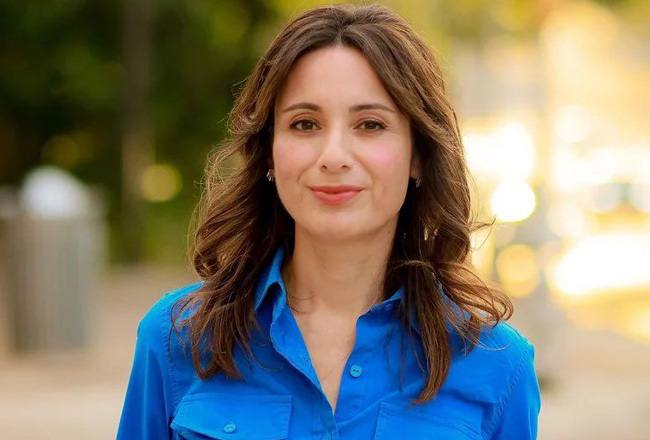
Texas hasn’t had a Democratic governor in more than three decades. Its next one went on Fox News this week and told Bret Baier, in plain terms, that she’s done helping ICE.
Gov.-elect Gina Hinojosa, who beat Greg Abbott earlier this month, sat down with Baier on Thursday. He asked her straight out whether Texas would stop cooperating with Immigration and Customs Enforcement once she takes office.
“We have had people killed, Americans, killed in the streets,” Hinojosa told him. “That needs to end. I will not facilitate that.”
She added that even Donald Trump has acknowledged that ICE went too far.
She didn’t name anyone, but she didn’t have to. In January, federal immigration agents in Minneapolis shot and killed two American citizens less than three weeks apart. Renee Good, a 37-year-old mother of three, was killed by an ICE agent on Jan. 7. Alex Pretti, a 37-year-old ICU nurse, was killed by a Border Patrol agent on Jan. 24.
What makes Hinojosa’s answer worth paying attention to is that she didn’t walk away from border security to give it. She told Baier that ICE’s tactics and border security are a “separate thing,” and that she agrees with the border sheriffs she’s been talking to that Washington needs to put more resources on the border. This week she held a roundtable with sheriffs from all 16 Texas counties along the Mexican border, and said afterward that “the border is secure and will remain secure under my leadership.”
Her problem is with who’s paying for it. “Texas has spent $20 billion on border security,” she told Baier, and Texas taxpayers shouldn’t be “footing that bill to such an extent.” Operation Lone Star alone has cost the state $11 billion since Abbott launched it in March 2021, according to the Texas Tribune.
And unlike a lot of politicians who talk tough about ICE, Hinojosa is about to have real levers to pull.
Since Trump took office, some 350 Texas law enforcement agencies have signed task force agreements with ICE, the Texas Observer reported. These are the 287(g) deals that effectively turn local police into immigration agents. Most are county and city departments, but the list also includes the Texas National Guard, the state attorney general’s office and the criminal investigations and highway patrol divisions of the Texas Department of Public Safety, which had about 5,000 commissioned officers as of last year.
DPS can end those agreements at any time. On paper, that decision belongs to the agency’s director, and the commission that oversees DPS is made up entirely of Abbott appointees. But Randy Erben, Abbott’s former legislative director, told the Observer that “agencies are not going to continue conduct that the governor, once she takes office, is unhappy with on a regular basis.”
Then there’s Operation Lone Star itself. Abbott built it on a border disaster declaration that the governor has to keep renewing, and the Tribune counted 69 renewals since 2021. Those declarations let him send National Guard troops and state troopers to the border and impose harsher criminal penalties on people who cross, all without going through the Legislature. A new governor can simply stop signing them.
Hinojosa has called Operation Lone Star “political theatre,” and said in October that it “needs to only exist to make us safer.” She has also said she’ll review whether it’s legal at all.
She isn’t promising to tear everything down overnight. She has said she won’t try to overturn the state law requiring county jails to work with ICE. “I will always follow the law,” she told the Washington Post, even as she called ICE’s enforcement inside the state “chaotic and dangerous” and said it “has to stop.”
Another state law passed last year, Senate Bill 8, requires nearly every sheriff in Texas to apply for an ICE agreement, and starting in December it lets the attorney general sue sheriffs who don’t. In January, that job goes to Democrat Nathan Johnson, and the Observer reports the new administration isn’t likely to go after sheriffs who drag their feet. Harris, Dallas and Travis counties, three of the biggest in the state, still haven’t signed one.
Local leaders aren’t waiting for her, either. Since the election, Houston and Austin have both moved to scale back how closely their police work with ICE.
Dani Marrero Hi, deputy director of the Rio Grande Valley group La Unión del Pueblo Entero, told the Observer that “Gov.-elect Gina Hinojosa has the power to scale back Operation Lone Star.”
Trump, for his part, doesn’t seem rattled. After a phone call with Hinojosa, he told reporters that “she was really nice” and that “it was a very productive call, and she wants to have a strong border.” He added, “I think we’ll be able to work something out.”
Hinojosa, who grew up in the Rio Grande Valley, will be sworn in on Jan. 19. She’ll be the first Democrat to run Texas since Ann Richards, and the Observer notes she’ll be the first Hispanic governor in the state’s history.
Greg Abbott spent years busing migrants to blue cities to make a point. His successor just went on Fox News to make a very different one.