
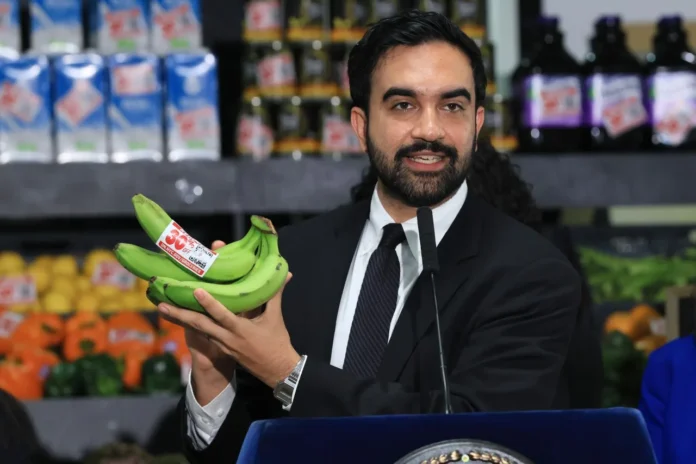
New York’s supermarket lobby went to federal court to stop Mayor Zohran Mamdani’s city-owned grocery stores.
It lost.
Last week, Judge Jennifer Rochon rejected the National Supermarket Association’s bid to block the plan. The group, which represents more than 400 supermarkets in the city, claimed the stores would use “predatory” pricing. The judge didn’t buy it. Low prices only break the law when they’re a scheme to wipe out competitors and then jack prices back up, and nobody showed that here.
So critics are falling back on their other line: cheap groceries are bad for business.
They’re not. They’re bad for greed. And they’re good for people.
Here’s the plan. Five stores, one in each borough, run by a private operator on city property. Once a month, the city sets prices on a basket of staples like produce, meat, bread, rice and beans at 30% below typical retail. The stores won’t sell cigarettes, alcohol, lottery tickets or hot food, the things corner bodegas count on.
At the DealBook Summit, Andrew Ross Sorkin asked Mamdani how the math could possibly work when supermarkets make just 1% to 4%. “It’s going to be subsidized,” the mayor said. Fox Business called that a dodge.
It’s actually the whole point. So who pays? Taxpayers do. And it’s a bargain.
Building all five stores costs $70 million, once. The city’s budget this year is $125.84 billion. That’s less than a tenth of 1%. The city spends about $507,000 a year to keep one person in jail, according to the comptroller. The entire grocery plan costs about what it takes to jail 140 people for a year.
Hunger is already on our tab. About 1 in 5 New Yorkers can’t reliably afford food, including 1 in 4 kids, according to Feeding America. A 2019 study found that adults in that spot rack up about $1,834 more a year in health care, and plenty of that bill lands on taxpayers.
Feeding people even cuts crime. When Illinois spread food stamp payments across the month, economists found crime fell 17.5% and grocery store theft fell 20.9%.
A sandwich is a lot cheaper than a cell.
And the city already subsidizes groceries. It just hands the money to private chains. Its FRESH program has given supermarkets $29.2 million in tax breaks, and the military runs 238 grocery stores with about $1.4 billion a year from Congress. Nobody calls that socialism.
Not every public grocery store has worked. A town-run store in tiny Baldwin, Florida, closed after it couldn’t land a big distributor and ended up charging more. New York has millions of shoppers. Scale isn’t our problem.
Prices are. Grocery costs in the New York area jumped 65.8% in a decade, far faster than the 48.8% nationwide, the state comptroller found. The Federal Trade Commission found that big chains raised prices faster than their own costs went up.
Mamdani told the room full of CEOs exactly what he’s going for. “I want the public sector to be so good that the people in this room, no matter how much money they may have in their pocket, will choose to use that public sector,” he said.